Eine Sekunde, wir bereiten alles für Sie vor...
Back to Tools & GuidesAdvanced Assembly
IntelliJ Platform Pluginv1.0.2CLion 2026.1.1156 tests
Advanced Assembly
Plugin for CLion
First-class NASM x86/x86-64 and MIPS support — syntax highlighting, context-aware completion, inspections, project wizard, and end-to-end debug through QEMU and GDB. On Windows, everything routes transparently through WSL.
1
.data2
msg: .asciiz "Hello, World!\n"
3
4
.text5
.globl __start
6
7
__start:8
# Print string to stdout
9
li $v0, 4004 # sys_write
10
li $a0, 1 # stdout
11
la $a1, msg # buffer
12
li $a2, 14 # length
13
syscall
14
15
# Exit program
16
li $v0, 4001 # sys_exit
17
li $a0, 0 # status
18
syscall
Debugger paused — line 13
Who it's for
Architecture students
A real IDE for assembly coursework — breakpoints, registers, stepping that actually work. Not SPIM, not MARS.
Systems developers
Hand-rolled assembly in C projects where .nasm and .s files should be first-class citizens in CMake builds.
Course staff
One-install setup to hand students instead of "now please configure your toolchain manually."
Supported languages
Two ISAs students and systems programmers actually use
NASM
Intel x86 / x86-64NASM 2.x syntax, Intel-style + %-prefixed preprocessor directives.
MIPS
MIPS32 / MIPS-I, Linux o32 ABIGAS-style directives, Linux o32 syscall ABI (sys_write = 4004, sys_exit = 4001).
What it does
Everything the plugin adds to CLion
Editing
- Lexer-driven syntax highlighting with semantic promotion for registers and mnemonics
- Brace matching, block comments (;/# toggle), folding by label and section
- Structure view — .text / .data / .bss at top level, labels nested underneath
- Auto-closing quotes in .data and operand position — typing " or ' inserts the matching quote (NASM " and ', MIPS "); half-typed openers still lex as a string to end-of-line
- Live templates: prol, epil, exit, wrt, main, dataz (NASM) · prol, epil, exit, pri, prs, rdi, main (MIPS) · lbldoc expands a tab-stop label-doc comment block
- Opinion-free reindentation formatter
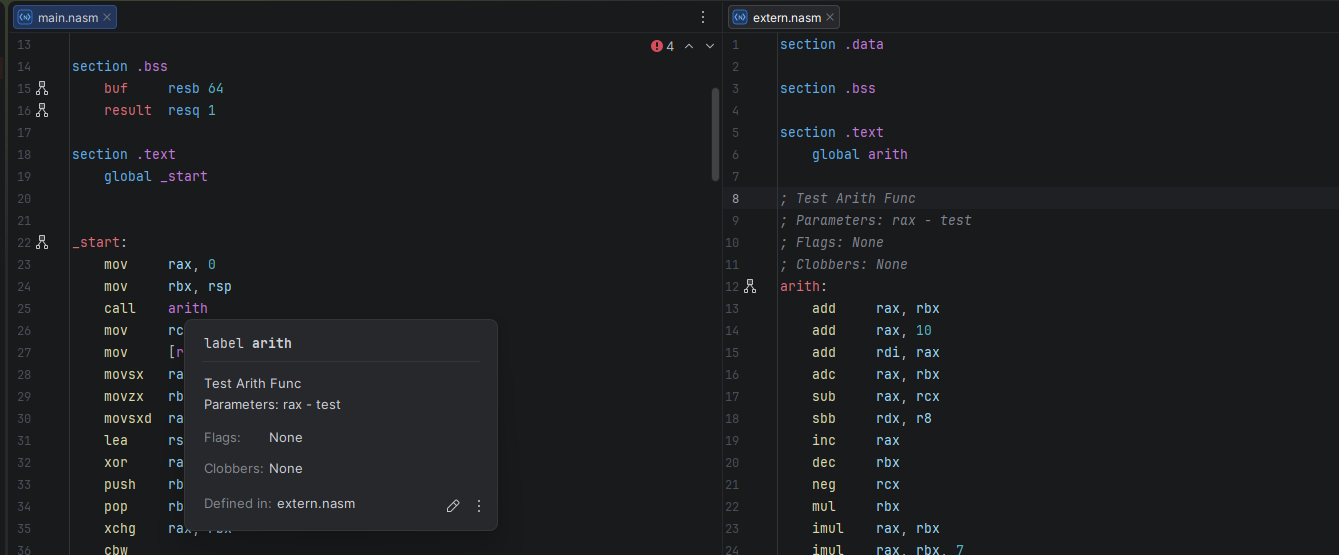
Debug pipeline
The piece that took the longest to get right
Source
.mips / .nasm
Assemble
--gdwarf-2
QEMU
User-mode emulation
GDB
Multiarch attach
Debug
Source-level stepping
Hit Debug → Before-Launch assembles with --gdwarf-2 for real DWARF, links with -e __start, starts qemu-mips-static -g <port> detached. CLion attaches its bundled multiarch GDB — no need to install gdb-multiarch in WSL. Path mapping translates /mnt/c ↔ C:\ so breakpoints bind on the right file.
Walkthroughs
Step-by-step from project creation to debug
1
Create project
File → New → Project → Assembly. Name it hello, language NASM, format elf64, mode Pure ASM.
2
Auto-configure
CLion opens with CMakeLists.txt and main.nasm. CMake configures automatically; the run-config dropdown populates.
3
Run
Click ▶. The template calls exit(0). Add a sys_write call (or use the wrt live template) and run again.
Setup
One command on Linux/macOS, a few steps on Windows
🐧
Linux / macOS
Install the cross-toolchain. The plugin auto-detects binaries on PATH.
# Debian / Ubuntu
sudo apt install nasm gcc-mips-linux-gnu \
  qemu-user-static gdb make ninja-build
🪟
Windows (WSL)
- Install WSL with Ubuntu-24.04 (avoid docker-desktop as default distro — no apt)
- Inside WSL, install the same toolchain as Linux
- CLion → Settings → Toolchains → + → WSL. Pick your distro
- On project open, the plugin notifies of missing tools with a copy-pasteable
sudo apt install
Behind the scenes
Things that took an afternoon to track down
CLion ships multiarch GDB since 2026.1
No need to install gdb-multiarch inside WSL. The bundled debugger supports mips, arm, riscv, aarch64 out of the box.
pkill -f matches its own cmdline
Stale QEMU cleanup uses qemu-mips-stati[c] — the regex character class ensures pkill matches the emulator but not the cleanup script itself.
Coexists with other assembly plugins
NasmLanguage and MipsLanguage call Language.findLanguageByID before registering, so if a third-party plugin has already claimed the same language ID the IDE reuses it instead of crashing on startup with an ImplementationConflictException.
What it deliberately doesn't do
- Doesn't replace your assembler — real correctness checks come from nasm / mips-linux-gnu-as via the external annotator.
- Doesn't parse NASM macro bodies — %macro / %if are lexed but not modeled.
- Doesn't support full-system QEMU — user-mode only (qemu-mips-static, qemu-x86_64-static).
- Doesn't yet do macOS NASM cross-arch — deferred behind a single feature flag.
Stack & Links
Stack
- Kotlin 2.3.0 — hand-written plugin code
- Java — Grammar-Kit / JFlex generated PSI, parser, lexer
- IntelliJ Platform Gradle Plugin 2.16.0 + Grammar-Kit sub-plugin
- 156 tests —
./gradlew test